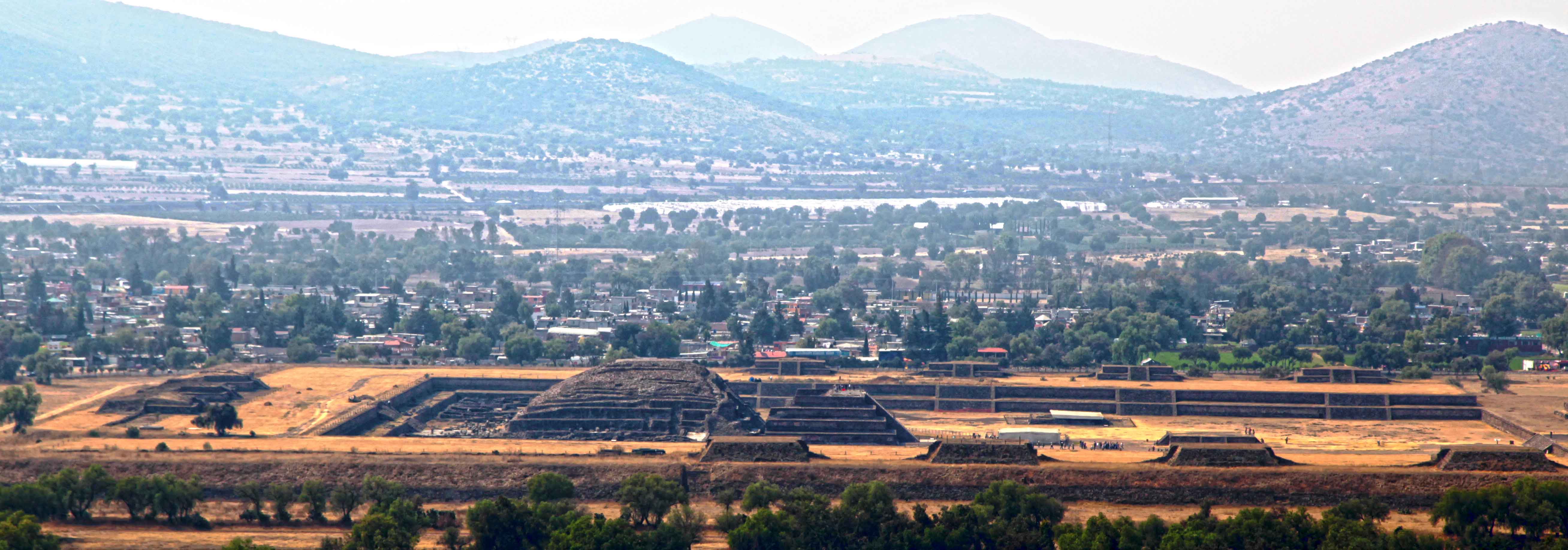
 Teotihuacan The Citadel
The Citadel, meaning fortress, was named by the Spanish when they first saw the immense quadrangle framed with fifteen symmetrically arranged pyramids. Four walls surround an inner patio and a few structures, including the Feathered Serpent Pyramid, are located in the central area and are believed to be constructed around 150 to 200 AD.
While the Citadel appears now to be located at the southern tip of the archeological site, it was likely located at the heart of the city when the Avenue of the Dead extended southward to a large part of Teotihuacan.
The walls measure around 400 meters (1312 feet) on each side and it is estimated by archeologist that the enclosed patio could hold 100,000 people for rituals and political performances. On both sides of the Feathered Serpent Pyramid are dense apartment complexes believed to be residential quarters of the ruling elite.
Throughout the investigation of the Citadel, including the internal pyramids various caches of skeletons of sacrificial victims have been found. Of the 150 or so, most appear to be young men, warriors from Teotihuacan, interred with detail and precision. Many with their hands tied behind their backs. In the construction of the pyramid, a single sacrificial victim was placed at each of the four corners with sacrificial offerings including 14 obsidian projectile points and 400 pieces of shell forming a rectangular plaques simulating human teeth.
In to foreground is an altar. The area under white tarps, a shaft tunnel believed to pre-date the Citadel and other structures, is currently under investigation.
Work is currently being conducted just in front of the pyramid structure, Archeologists are investigating a vertical tunnel that was built prior to the building of the Citadel around 100 BC and postulate that this was the most important religious feature of the city and the reason the surrounding Citadel was built. Caves were considered direct connections with the Gods and the underworld.
The cave tunnel may also be the place that rituals regarding the creation of the earth were enacted and perhaps royal personages were buried. Workers have uncovered jade from Guatemala, serpentine, shell, slate and obsidian believed left as an offering. Hopes are that they find more clues to the origin of the City and perhaps an intact tomb of a leader.